
Search Cherokee County Traffic Records
Cherokee County traffic records are primarily handled through the Magistrate's Office when the summons is a county magistrate matter. The official Magistrate traffic court information page describes court appearances, cash bond, mailed bond, trial rights, failure-to-appear consequences, and appeals. It should not be read as a promise that every ticket can be paid online. The summons controls whether the person must appear.
The county page is titled "Cherokee County Seventh Judicial Circuit Online Payments," but the text gives several non-online channels. A traffic court record can be visible in a court case search, tied to a court roster date, handled through a payment or bond workflow, or later reflected on an SCDMV driver record. The safest sequence is to read the front of the summons, check the court named there, and contact the traffic clerk if the amount, officer name, summons number, or appearance requirement is unclear.
- Read the summons and convert any military time before the court date.
- Use the county traffic page or the court named on the summons to identify the correct trial officer.
- Search or pay with the summons number, officer name, court location, and payment amount when payment is allowed.
- Appear for trial on the assigned date if contesting the citation or if appearance is required.
- Check SCDMV separately for points, license status, or certified driver history after disposition.
The official Magistrate traffic page is the source for local ticket handling.

The image reinforces that local traffic access is tied to Magistrate instructions, not a single statewide ticket database.
Cherokee County Traffic Courts
Traffic routing in Cherokee County depends on the officer, location, charge, and court named on the summons. The Magistrate Office handles civil, criminal, and traffic matters. Magistrate traffic records can involve county summonses, bond, trial officer action, failure to appear, and appeal notices. Municipal Court is separate. The South Carolina Judicial Branch says municipal courts are part of the trial-court structure and notes that some municipal records may not be available through the same county public-index route.
Circuit Court can matter after a traffic case when the violation becomes part of a larger criminal case, when a DUI or serious offense is prosecuted as a criminal case, or when a lower-court appeal requires notice to the Clerk of Court. The county traffic page says a person who disagrees with a trial outcome must send notice of appeal to the Clerk of Court, the magistrate, and the opponent within 30 days after judgment.
| Court or Office | Traffic Record Role | Contact Point |
|---|---|---|
| Cherokee County Magistrate's Office | County magistrate traffic summonses, bond, trial, failure to appear, and traffic clerk routing. | 312 E. Frederick Street, Gaffney; 864-487-2533. |
| Blacksburg Magistrate | Magistrate matters routed through the Blacksburg office. | 301 West Cherokee Street, Suite A, Blacksburg; 864-839-2492. |
| Municipal Court | City police, ordinance, parking, or city summonses when the ticket names a municipal court. | Use the court named on the summons. |
| Circuit Court / Clerk of Court | Appeal notice involvement and criminal-case routing for more serious traffic-related charges. | 125 E. Floyd Baker Blvd., Gaffney; 864-487-2571. |
Cherokee County Citation Lookup Fields
The linked payment portal could not be fully captured because of static and SSL limitations, but the county traffic instructions identify the key fields needed for mailed bond and payment routing. A summons number and arresting officer name are especially important. A driver name can help a clerk locate a case, but the summons controls the official court, date, and appearance rules.
| Field Label | Type | Required | Notes / Format |
|---|---|---|---|
| Summons number | Text | Likely yes | The county says to include it with mailed bond. |
| Arresting officer name | Text | Yes for mailed bond | The county says to enclose the officer's name. |
| Defendant or driver name | Text | Likely optional | Useful when asking a clerk to locate a case. |
| Court location | Selection | Likely | Gaffney and Blacksburg routing may differ. |
| Payment amount or bond | Currency | Yes when paying | Use the amount from the court or summons. |
| Search / Pay | Button | Yes | Payment-site fields were not fully captured. |
The Magistrate victim/witness source is also assigned to this page and is relevant when a traffic matter overlaps with criminal or domestic-violence court routing.

That source supports the broader point that some traffic-related records move through Magistrate criminal, preliminary hearing, or victim/witness channels.
Cherokee County Traffic Record Details
A court traffic record documents the court case. It may show the summons or citation, violation, officer, court date, bond, plea or trial outcome, fine and court costs, appeal, and failure-to-appear status. It does not replace a certified SCDMV driver history. A court result can lead to SCDMV points or suspension entries, but the driver record is held by a different agency.
| Field | What It Shows |
|---|---|
| Summons or citation | The ticket number used by the court or payment workflow. |
| Violation or charge | The traffic allegation, offense, or statute/code description. |
| Court date and time | The assigned appearance or trial time, often printed in military time. |
| Bond or payment | Cash bond, mailed certified funds, fine, cost, or forfeiture status. |
| Disposition | The result after plea, trial, dismissal, conviction, or other court action. |
| Appeal or failure to appear | Appeal notice activity or license-suspension notice after missed court. |
Note: A summons time of 1400 means 2:00 p.m., but the exact court time printed on the summons controls.
Pay or Contest Traffic Tickets
If the front side of the summons requires court appearance, the person must appear at the appointed time and bring a South Carolina driver's license if the summons says so. A person may post cash bond with the appropriate trial officer's office before the trial date. If mailing bond, use money order, cashier's check, or certified check payable to Cherokee County Magistrates Office and mail it to P.O. Box 336, Gaffney, SC 29342. Do not mail cash or a personal check.
Payment does not erase trial rights under the county's stated instructions. The county says posting bond before trial does not affect the right to a fair trial by judge, or by jury if a written request is made at least five working days before the scheduled trial. If bond was posted and the person does not appear on the trial date when appearance is not required, the bond may be forfeited unless the judge agreed to another hearing time.
- Mailing bond: include the arresting officer's name and summons number.
- Contesting the ticket: appear for trial on the assigned date.
- Jury trial: make the written request at least five working days before trial.
- Rescheduling: contact Magistrate Court before the date and be ready to give a valid reason.
- Appeal: send notice to the Clerk of Court, magistrate, and opponent within 30 days after judgment.
Traffic Record vs Driver Record
The court traffic record and the SCDMV driver record answer different questions. The court record shows what happened in the case. The driver record shows licensing consequences, points, suspensions, reinstatement transactions, and certified driving history. A person may need both records after a ticket, especially if the case involved a missed court date, bond forfeiture, commercial license issue, or insurance request.
| Record Type | Source | What It Shows | How to Access |
|---|---|---|---|
| Court traffic record | Cherokee County Magistrate, municipal court, Public Index, or payment workflow. | Summons, charge, court date, bond, plea/trial result, fine, cost, appeal, and failure to appear. | Use the court named on the summons or the Cherokee County Magistrate traffic route. |
| State driver record | SCDMV. | Points, license status, certified driver history, suspensions, reinstatement, and related driver transactions. | Use SCDMV driving-record and transaction portals. |
The SCDMV driving record page is the official source for state driver-record access.
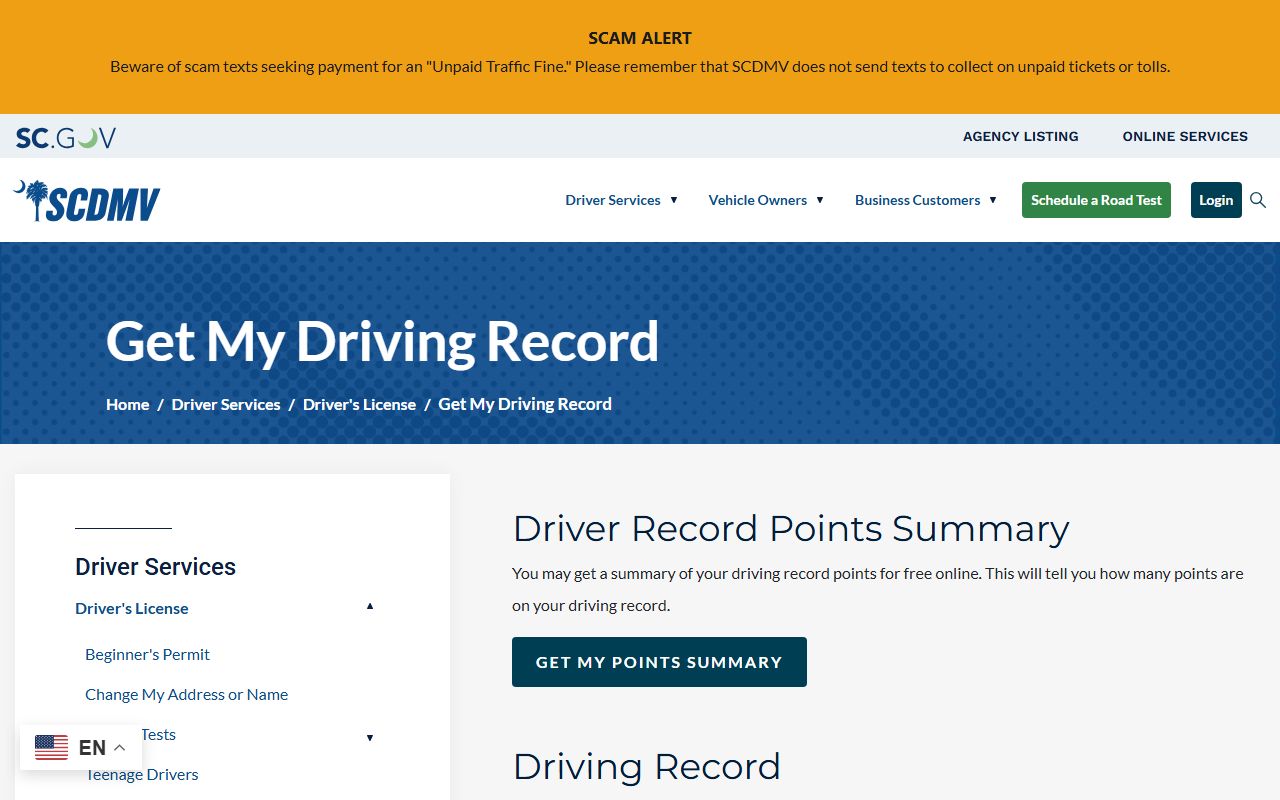
That state page belongs in the workflow only after the user understands it is separate from the Cherokee County court case file.
SCDMV Points and Transactions
SCDMV offers driver-record and points tools that are not county court records. Research found a free online points summary, a certified driver record transaction, collision report access, and reinstatement-fee transactions. These tools can matter after a Cherokee County ticket because the county traffic page says failure to post bond or appear can be reported to the home state's Motor Vehicle Division, leading to suspension until the matter is cleared with the trial court.
| Field or Transaction | Type | Notes |
|---|---|---|
| Driver Record Points Summary | Online transaction | SCDMV says the points summary is free online. |
| Certified Driver Record | Online transaction | Used when an official driver history is needed. |
| Driver license / ID data | Text and date fields | Exact fields were not captured; expect identity and license data. |
| Collision Report | Separate transaction | Listed separately from driver-record products. |
| Reinstatement Fees | Separate transaction | Used when license reinstatement is required. |
The SCDMV points system page explains the state point framework.
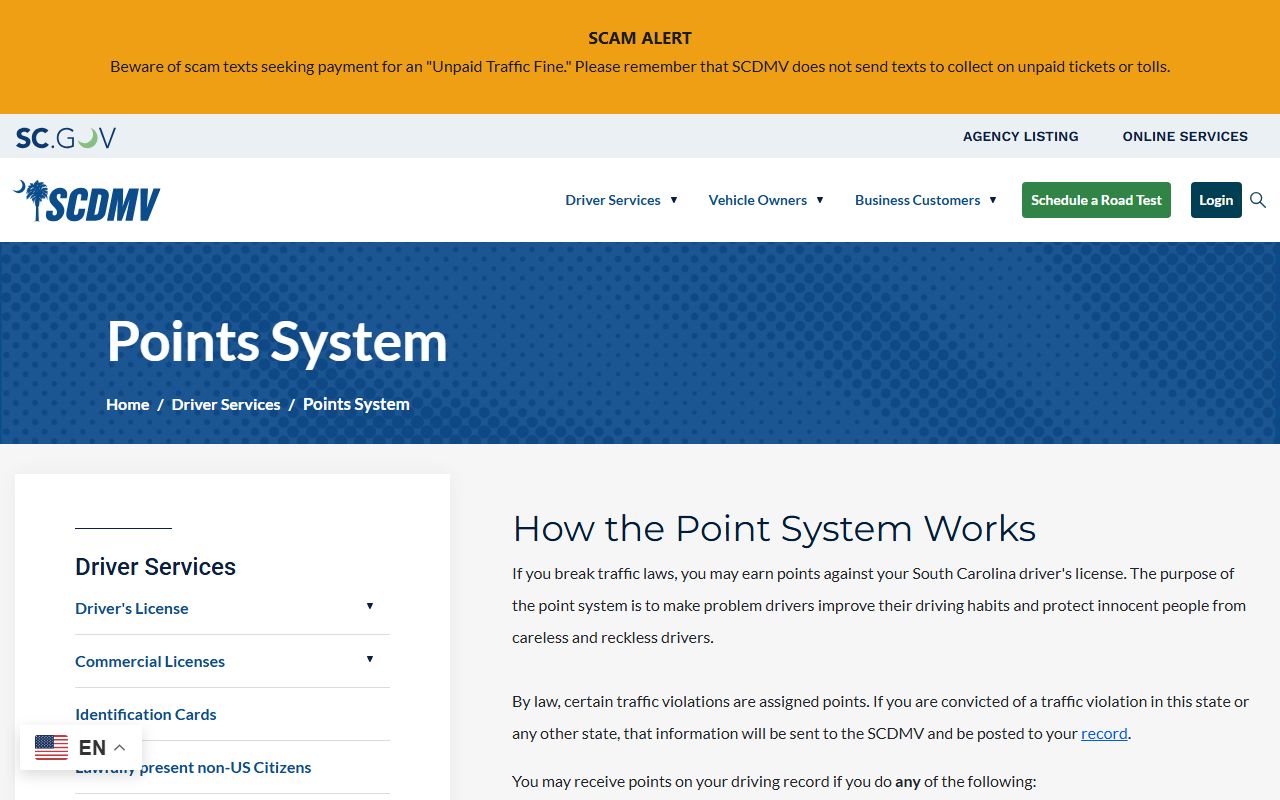
Points are a driver-record consequence, not the court's record of the summons, trial, or bond.
Cherokee County Traffic Access Laws
Traffic court records are court records, but access is still shaped by South Carolina public-record rules, Judicial Branch rules, and privacy limits. Cherokee County FOIA is useful for county-department records, but routine traffic case records should first be sought from the court handling the summons. Rule 610 is the better fit for judicial-record requests that fall outside normal case-copy channels. Some personal identifiers are restricted, and the state Judicial Branch says home addresses no longer display on the Public Index as of January 1, 2026.
Key access rules:
S.C. Code Title 30, Chapter 4 generally covers public records of public bodies unless an exemption or other law restricts disclosure.
Rule 610 judicial-record requests cover records maintained by courts and judicial-branch entities, with limits on bulk commercial requests.
S.C. Code Title 63, Chapter 19 keeps juvenile court and related records confidential except where law or court order allows access.
DUI and Commercial Traffic Records
DUI and other serious traffic-related charges can move beyond a simple citation record. Official court sources identify General Sessions as the Circuit Court criminal side and Magistrate Court as the place for summary-level criminal cases, bond court, preliminary hearings, domestic violence court, and traffic matters. If the traffic incident involved arrest, booking, or a criminal prosecution, check the court charge and criminal case record rather than treating it as a routine payment-only ticket.
Commercial driver record consequences are also separate from the court file. Official county sources did not provide a Cherokee-specific CDL deferral or defensive-driving program. For CDL or license-status effects, use SCDMV and the court named on the summons. For DUI or criminal traffic prosecution, the full case file belongs with Cherokee County criminal court records, not just a traffic payment receipt.
Cherokee County Traffic Fees
Official sources did not provide a flat traffic-record copy fee unique to Magistrate traffic cases. The Clerk of Court fee schedule is useful for Circuit and Clerk records, while Magistrate traffic costs and bond amounts depend on the summons, court, and trial officer. Do not quote a filing fee as if it were a ticket fine. Confirm the traffic amount with the summons, the payment route, or the Traffic Clerk.
| Item | Amount or Rule |
|---|---|
| Mailed traffic bond/payment | Use money order, cashier's check, or certified check only. |
| Payee for mailed bond | Cherokee County Magistrates Office. |
| Mailing address for bond | P.O. Box 336, Gaffney, SC 29342. |
| Willful failure to appear or post bond | Separate offense punishable by fine up to $200 or imprisonment up to 30 days. |
| Clerk copy fee, when Clerk record applies | Copies are listed at $0.50 each; certification under seal is $10.00. |
| SCDMV points summary | SCDMV says the online points summary is free. |
The SCDMV public transaction list shows driver-record, certified driver-record, collision-report, and reinstatement-fee transactions.
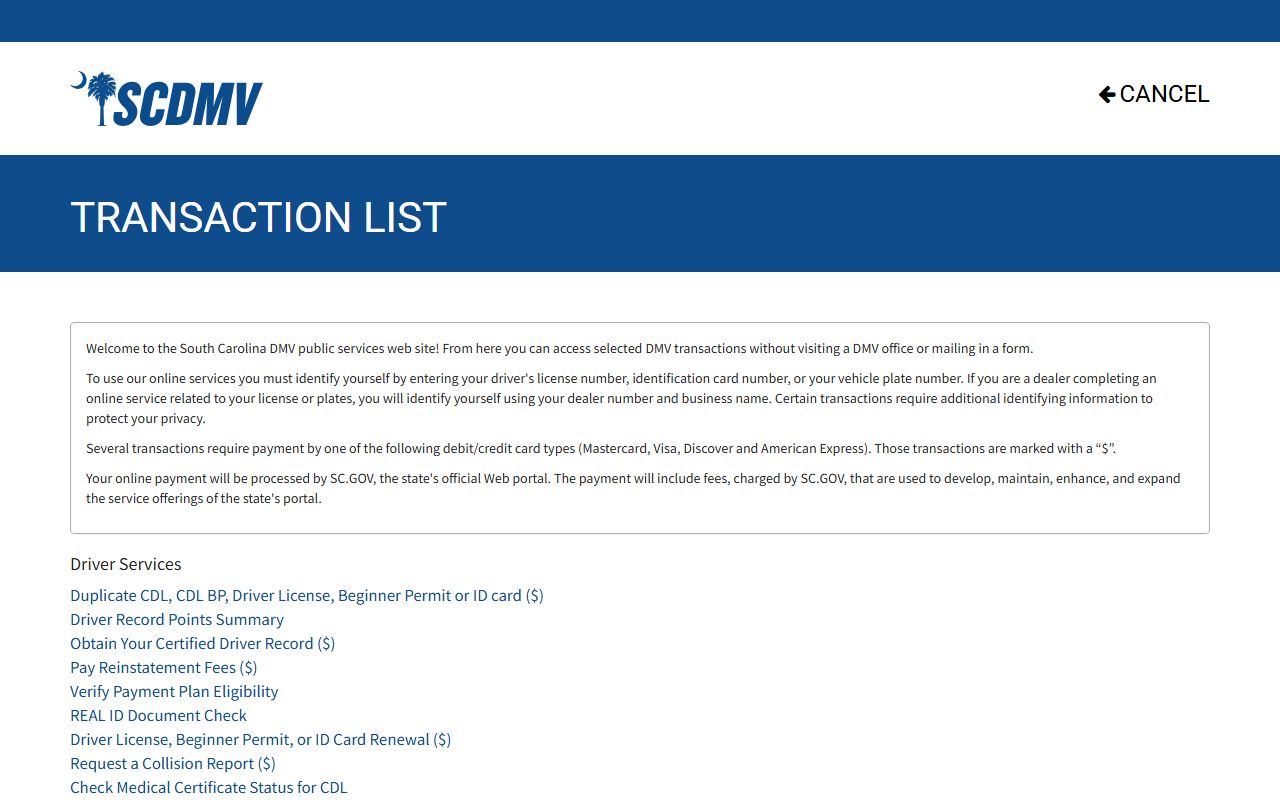
Use the transaction list for state driver-record products, not for changing a Cherokee County court disposition.
Municipal Tickets and Appeals
Municipal tickets are a common source of wrong-counter searches. Cherokee County links to the City of Gaffney and City of Blacksburg as major municipalities, and the state court system includes Municipal Court as a separate trial-court category. If the ticket names a municipal police officer or municipal court, use the court named on the summons. Some municipal records may appear through state case-record systems, but others may require the municipal court's own payment or clerk route.
Appeals are time-sensitive. The county traffic page says a person who disagrees with the outcome must send notice of appeal to the Clerk of Court, the magistrate, and the opponent within 30 days after judgment. The Clerk's role in appeal notice does not mean the Clerk can change the Magistrate result or extend a deadline without legal process.